Showing posts with label CSEM. Show all posts

Saturday, 22 October 2016

First, There Was The Word


 ... and the word was Censorship

*****

"ABSTRACT

The legal and psychological research surrounding online Child Sexual Exploitation Material (CSEM) is focused on visual depictions of children, either as still images or movies.

Narrative CSEM (N-CSEM) describes an under-researched area, resulting from difficulties surrounding its conceptualisation, both legally as well as concerning the function for its users.

The current study describes an initial attempt in defining N-CSEM in comparison to visual material, based on interviews with users of CSEM and N-CSEM and professionals working with this user group.

Thematic Analysis resulted in three super-ordinate themes. All themes were analysed and enriched from the perspectives of user- and service-representatives.

The study provides insight into N-CSEM as a separate entity from visual CSEM, challenging and informing legal decision-making and assessment and treatment providers for users of CSEM.

KEYWORDS: Child sexual exploitation material, Narrative Child Sexual Exploitation Material, thematic analysis, child abusive images, online sex offending"

http://www.tandfonline.com/doi/full/10.1080/1068316X.2016.1239099?needAccess=true& 

*****

2 December 2014 

Who was the Marquis de Sade really?

http://www.telegraph.co.uk/books/authors/who-was-the-marquis-de-sade-really/

Friday 14 November 2014

Marquis de Sade: rebel, pervert, rapist...hero? 

http://www.independent.co.uk/news/world/europe/marquis-de-sade-rebel-pervert-rapisthero-9862270.html 

February 2015 

Who Was the Marquis de Sade?

http://www.smithsonianmag.com/history/who-was-marquis-de-sade-180953980/?no-ist

Marquis de Sade

https://en.wikipedia.org/wiki/Marquis_de_Sade

*****
(Embedded Tweet - click date)

Monday, December 19, 2016 

My soul is criminal 

"We live in ever more hateful times. This ongoing prosecution, in which a suspended policeman is charged with the newly invented crime of reading erotic short stories, pushes the envelope of feminist sex-hostility another notch forward and inspired the following essay from me.

When words are criminal, so are thoughts. Whether thoughts are written down or not makes no moral difference, and any words that sexualize a minor are criminal. My opinions on "child" sexuality (referring to anyone under 18) are fundamentally criminal, and only technical and resource limitations (mind reading technology is not there yet) prevents the state from convicting and imprisoning me. Notice that the law covers every medium of thought currently accessible to the police, and if they could read our thoughts directly, they would surely do so and base their prosecution on it."

http://eivindberge.blogspot.co.uk/2016/12/my-soul-is-criminal.html

Google Translation of the original case.

Wednesday, 19 October 2016

Distorted Cognitions


Sure?

*****

Also, see The Eikonophobiacs Are On the Move - Again and Beginning To Understand.

*****
(Embedded Tweets - click date)

*****

Gateway to offending behaviour: permission-giving thoughts of online users of child sexual exploitation material 

Danielle G. Kettleborough & Hannah L. Merdian

Received 19 Nov 2015, Accepted 30 Aug 2016, Published online: 18 Oct 2016 

ABSTRACT 

"The endorsement of permission-giving thoughts, or so-called cognitive distortions, has been discussed as a contributing factor in sexually abusive behaviour.

The current study set out to explore the thinking patterns of offenders who have used/downloaded child sexual exploitation material (CSEM), based on a survey of professionals.

A thematic analysis elicited four overarching themes, namely the Perceived Nature of Children (perception of children portrayed in CSEM, as well as children in general), Non-sexual Engagement with CSEM (motivating factors that are not inherently sexual in nature), Denial of Harm (perception of the level of harm caused by CSEM), and Expression of a General Sexual Preference (general interest in deviant sexual behaviour).

These themes aid to explore the differences and similarities between contact and non-contact offenders and to improve the understanding of the role of permission-giving thoughts in this typology of offending."

Results are discussed in terms of their theoretical significance and future implications.

KEYWORDS: Child pornography, child sexual exploitation material, cognitive distortions, sex offending, internet sex offending,

http://www.tandfonline.com/doi/full/10.1080/13552600.2016.1231852?needAccess=true

http://dx.doi.org/10.1080/13552600.2016.1231852

D. Kettleborough @DGKettle https://twitter.com/DGKettle

Hannah Merdian @HlMerdian https://twitter.com/HlMerdian

*****

A fundamental attribution error? Rethinking cognitive distortions

Shadd Maruna & Ruth E. Mann

First published: September 2006

Abstract 

"The notion of ‘cognitive distortion’ has become enshrined in the offender treatment literature over the last 20 years, yet the concept still suffers from a lack of definitional clarity.

In particular, the umbrella term is often used to refer to offence-supportive attitudes, cognitive processing during an offence sequence, as well as post-hoc neutralisations or excuses for offending.

Of these very different processes, the last one might be the most popular and problematic. Treatment programmes for offenders often aim to eliminate excuse-making as a primary aim, and decision-makers place great weight on the degree to which an offender “takes responsibility” for his or her offending. Yet, the relationship between these after-the-fact explanations and future crime is not at all clear.

Indeed, the designation of post hoc excuses as criminogenic may itself be an example of fallacious thinking. After all, outside of the criminal context, post hoc excuse-making is widely viewed as normal, healthy, and socially rewarded behaviour.

We argue that the open exploration of contextual risk factors leading to offending can help in the identification of criminogenic factors as well as strengthen the therapeutic experience. Rather than insist that offenders take “responsibility” for the past, we suggest that efforts should focus on helping them take responsibility for the future, shifting the therapeutic focus from post hoc excuses to offence-supportive attitudes and underlying cognitive schemas that are empirically linked to re-offending."

http://onlinelibrary.wiley.com/doi/10.1348/135532506X114608/abstract 

DOI: 10.1348/135532506X114608

Examining The Term 'Cognitive Distortions' 

"In short,

the concept of cognitive distortion has suffered both from an absence of empirical support and also from a lack of clarity in definition.

Over time, this lack of clarity has become increasingly problematic. Authors have broadened the concept of cognitive distortion in different ways; for example, using the term to describe general antisocial thinking (Ward, 2000).

In clinical practice, the term cognitive distortion has become confused with any causal explanation for offending given by offenders, no matter how valid the explanation might be (Mann & Webster, 2001).

Moreover, the cognitive distortion label is used to group together far different phenomena such as attitudes, cognitive products and post hoc excuses.

Hence, we will avoid the slippery term cognitive distortions altogether in our review below, and concentrate only on excuse making [...] We explicitly exclude attitudes which are supportive of offending, such as pro-violence attitudes or (in the case of sex offending) beliefs that child victims enjoy sex with adults or are not harmed by it."

"In this paper, we have suggested that some of the common assumptions about post hoc excuses (sometimes called cognitive distortions) are worthy of reinvestigation.

In particular, we point to a large body of literature that indicates excuse making is normal and frequently healthy, and we make the uncontroversial point that behaviours frequently do have external causes.

We suggest that, just because many offenders seek to excuse their offending by appealing to external, unstable causes, this does not justify the assumption that such an attributional style is risky. Such an assumption may mean that those concerned with understanding offending, whether through research or clinical practice, pay too little attention to other, perhaps more important, cognitive phenomena.

As always, more research is needed, but future work should maintain a more open, unbiased mind in regard to offender accounts and seek to avoid misattributions of labels such as cognitive distortion."

https://www.ipce.info/library/book/quotes-fundamental-attribution-error-intro

https://www.ipce.info/library/book/quotes-fundamental-attribution-error-rethinking

https://www.ipce.info/library/book/quotes-fundamental-attribution-error-rethinki-2

Monday, 22 June 2015

The Eikonophobiacs Are On the Move - Again


June 21, 2015

Permission-giving thoughts relating to child sexual exploitation material offending

“The children in the images were not harmed”: 

"Following on from the recent blog post detailing the development of the Children, Internet, and Sex Cognitions (CISC) scale, this post will further explore the findings from this research, focusing on the permission-giving thoughts endorsed by individuals with an offence related to child sexual exploitation material (CSEM).

The figure below provides examples of permission-giving thoughts endorsed by individuals with a child sex offence, as identified by Ward and Keenan (1999). A starting point in the research that colleagues and I carried out was to explore whether these thoughts can be applied to individuals with a CSEM related offence."

https://nextgenforensic.wordpress.com/2015/06/21/the-children-in-the-images-were-not-harmed-permission-giving-thoughts-relating-to-child-sexual-exploitation-material-offending

(Embedded Tweets, click date)

*****

Published 24 Dec 2010; DOI: 10.1348/135532506X114608; Volume 11 Issue 2 (September 2006), Pages 155-339

A Fundamental Attribution Error? Rethinking Cognitive Distortions

"The notion of ‘cognitive distortion’ has become enshrined in the offender treatment literature over the last 20 years, yet the concept still suffers from a lack of definitional clarity.

In particular, the umbrella term is often used to refer to offence‐supportive attitudes, cognitive processing during an offence sequence, as well as post‐hoc neutralisations or excuses for offending.

Of these very different processes, the last one might be the most popular and problematic.

Treatment programmes for offenders often aim to eliminate excuse‐making as a primary aim, and decision‐makers place great weight on the degree to which an offender “takes responsibility” for his or her offending.

Yet, the relationship between these after‐the‐fact explanations and future crime is not at all clear. Indeed, the designation of post hoc excuses as criminogenic may itself be an example of fallacious thinking. After all, outside of the criminal context, post hoc excuse‐making is widely viewed as normal, healthy, and socially rewarded behaviour.

We argue that the open exploration of contextual risk factors leading to offending can help in the identification of criminogenic factors as well as strengthen the therapeutic experience.

Rather than insist that offenders take “responsibility” for the past, we suggest that efforts should focus on helping them take responsibility for the future, shifting the therapeutic focus from post hoc excuses to offence‐supportive attitudes and underlying cognitive schemas that are empirically linked to re‐offending."

http://webcache.googleusercontent.com/search?q=cache:RPymCHeJR9oJ:citeseerx.ist.psu.edu/viewdoc/download%3Fdoi%3D10.1.1.352.2987%26rep%3Drep1%26type%3Dpdf+&cd=23&hl=en&ct=clnk&gl=uk

http://citeseerx.ist.psu.edu/viewdoc/download?doi=10.1.1.352.2987&rep=rep1&type=pdf

http://psychsource.bps.org.uk/details/journalArticle/3355871/A-fundamental-attribution-error-Rethinking-cognitive-distortions.html

http://onlinelibrary.wiley.com/doi/10.1348/135532506X114608/abstract

*****

March 20, 2011, doi: 10.1177/0306624X11402945 Int J Offender Ther Comp Criminol May 2012 vol. 56 no. 3 465-482

Making Sense, Making Good, or Making Meaning? Cognitive Distortions as Targets of Change in Offender Treatment

"Abstract

Most structured sex-offender programs are based on a cognitive-behavioural model of behaviour change.

Within this overarching theoretical paradigm, extensive use of cognitive distortions is seen as a central core symptom among sex offenders.

However, the literature on cognitive distortions lacks a clear and consistent definition of the term. 

It is unclear whether cognitive distortions are consciously employed excuses or unconscious processes serving to protect the offender from feelings of guilt or shame. 

In this article, the dominant cognitive-behavioural interpretation of cognitive distortions is contrasted with two alternative interpretations.

One is based on an attributional perspective and the notion of attributional biases. 

The other explanation is based on a narrative approach focusing on the action elements of cognitive distortions, that is, as something people do rather than something they have. 

Clinical implications of these alternative conceptualizations are discussed and illustrated throughout by a case example."

http://ijo.sagepub.com/content/56/3/465.abstract

*****

Received: 20 Aug 2012 Accepted: 28 Feb 2014 Published online: 07 Apr 2014

The Endorsement of Cognitive Distortions: Comparing Child Pornography Offenders and Contact Sex Offenders

http://www.tandfonline.com/doi/abs/10.1080/1068316X.2014.902454#.VYeIylJS-M8

*****
(Embedded Tweets, click date)

Monday, 6 April 2015

Danielle - We Fear She Is Destined For The Dark Side :(


Darth Danielle


*****
(Embedded Tweet - click date)

5/4/15 

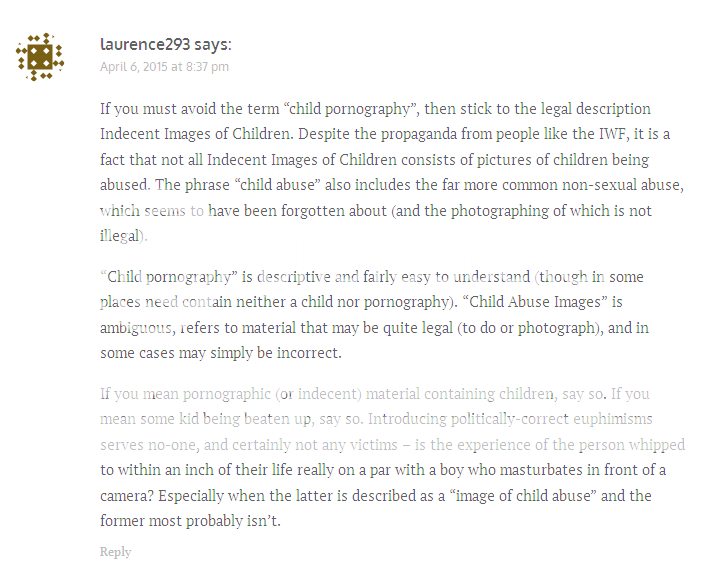
What’s wrong with “child pornography”? The impact of terminology 

https://nextgenforensic.wordpress.com/2015/04/05/whats-wrong-with-child-pornography-the-impact-of-terminology/comment-page-1/#comment-196

Image Removed By Request (click on it, above)

The 'Scientific' Tower of Babel

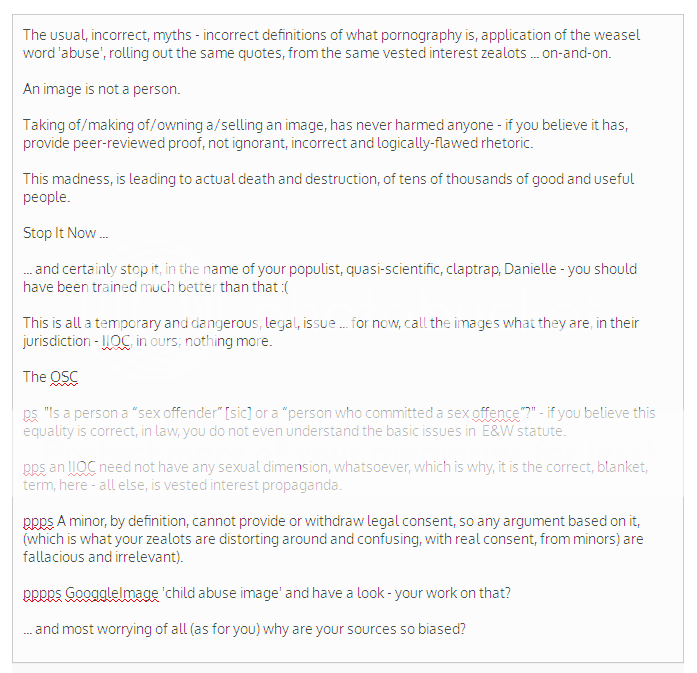
Well, here is a partial and rapid-response, for you all ...


 ... at 4:09 am, 7/5/15, our comments were still 'awaiting moderation', even though others had been cleared. 


... and, no, Danielle, this is never a personal issue, with us :( 

The OSC

ps If you really need a neutral, globally-applicable term, then, that term is a 'Potentially-Illegal Image' and, consequently, an 'Illegal Image'.

 *****
(Embedded Tweet - click date)

... never let it be said, that we are not nice, reasonable, folk :)

The OSC

Sunday, 8 February 2015

Beginning To Understand


 So many questions ...

*****
(Embedded Tweets - click date)

*****

Feb 8 2015

Understanding the cognitions of child sexual exploitation material offenders

Danielle Kettleborough

https://nextgenforensic.wordpress.com/2015/02/08/understanding-the-cognitions-of-child-sexual-exploitation-material-offenders/

*****

28 July 2014 

What Predicts Crossover From Viewing CSEM To Engagement In Sexual Contact

http://prezi.com/7rtuf7oduqjb/?utm_campaign=share&utm_medium=copy&rc=ex0share

https://prezi.com/7rtuf7oduqjb/what-predicts-the-crossover-from-viewing-csem-child-pornog/#

*****
(Embedded Tweet - click date)

*****

“Let’s Talk About Sex”: FCRG One-Day Conference 

"The FCRG are pleased to announce that, on Thursday 14th May, an exciting one-day conference will be taking place at the University of Lincoln, entitled “Let’s Talk About Sex in Sexual Offending Research and Practice”."

http://fcrg.blogs.lincoln.ac.uk/2015/02/19/lets-talk-about-sex-fcrg-one-day-conference/
(Embedded Tweet - click date)

Monday, 13 January 2014

Thought Crimes Under A Spotlight - New Label Created ... 'CSEMOs'

1/5/2014

From “looking” to “touching”? Conference on Risk in Offenders who use Child Sexual Exploitation Material ['use' what?]


"Dr Hannah Merdian is,together with Prof Derek Perkins (Surrey University & West London Mental Health NHS Trust), organising a one-day conference addressing the issue of risk assessment and risk management in working with child sexual exploitation material (CSEM) users. The conference is both for an academic audience and professionals who work with CSEM User or their victims. The conference will take place in London on the first of May and brings together a range of leadings researchers and practitioners to investigate how likely a CSEM user is to commit a contact sex offence against a child in the future? Is there a causal link between “looking” and “touching”?

To find out more and register for the event, download the conference flyer as a pdf here ...

http://psychologynews.blogs.lincoln.ac.uk/files/2014/01/Conference-Flyer.pdf

http://psychologynews.blogs.lincoln.ac.uk/2014/01/13/from-looking-to-touching-conference-on-risk-in-offenders-who-use-child-sexual-exploitation-material

*****

(Embedded tweets - click date. Full content captured, if required.)

*****

Dr Hannah Merdian

http://staff.lincoln.ac.uk/hmerdian

Hannah Merdian Presents to Leading Researchers

http://fcrg.blogs.lincoln.ac.uk/2013/11/19/hannah-presents-to-leading-researchers

Prof Derek Perkins

http://www.zoominfo.com/p/Derek-Perkins/1234009824

D. Kettleborough @DGKettle

https://twitter.com/DGKettle

*****

Have You Learned Nothing? - Causality and Correlation of Owning Images - The OSC

http://therealosc.blogspot.co.uk/2013/07/have-you-learned-nothing.html

Greater Than 30% Of IIOC Viewers Are 'Hands-On Paedos' - How Did This Mythology Arise? - The OSC 

http://therealosc.blogspot.co.uk/2013/08/greater-than-30-of-iioc-viewers-are.html