*****
ATSA Conference - Chicago, IL - Nov 3, 2013 -
Session Abstracts
https://atsa.nonprofitcms.org/conference/Conferences/1/Pages/Session%20Abstracts
*****
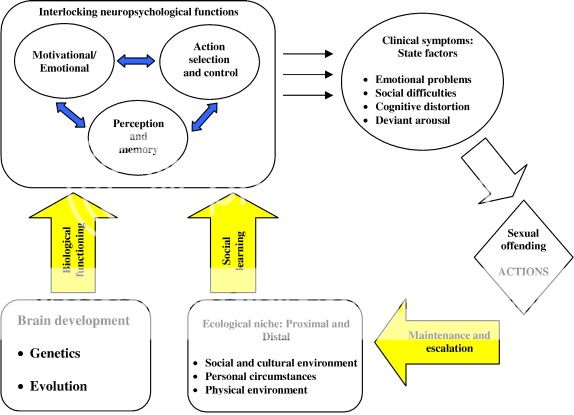
Applying SO theory to online offenders
http://prezi.com/s4rzmrrhj95i/applying-so-theory-to-online-offenders
*****
Characteristics of Internet Sex Offenders: Theory, Updated Research, and Future Directions
Symposium Chair: Ian A. Elliott, Ph.D.
"Over the past two decades there has been a concerted effort to improve our understanding of individuals who use the internet to commit sexual offences. This effort has combined theoretical understanding of the phenomenon with empirical research to examine and test our assumptions about this population. Although there have been considerable advances in recent years, developing our understanding of internet sex offenders continues to be muddied by the inherent difficulties in defining the population and delineating between internet offending behaviors, with many questions remaining unanswered.
For example, much of the prior research is based on an assumption that traditional sex offender theory and its constituent concepts can be applied to the internet offender population. Is there an adequate rationale for this? The issue of offence cross-over continues to be problematic. Many studies have combined individuals who have committed both child pornography and contact offences with those who have solely committed child pornography offences. But are mixed offenders different from those who engage in one type of offending behaviour exclusively? Also, much of the research in this area has focused on those who access child pornography online, whereas those who use the internet to communicate directly with children have received less attention. Are those who solicit minors for cybersex’/sexualized communication over the internet different than child pornography offenders?
This symposium aims to bring together a mix of research and theory from Canada, the United Kingdom, and the United States in order to address some of these questions. In the first presentation, Ian Elliott will examine the applicability of current sex offender theory to the internet sex offender population and highlight outstanding questions. In the second, Kelly Babchishin will present findings from an updated meta-analysis comparing traditional contact sex offenders to different types of online sex offenders. In the third presentation, Juliane Kloess will report findings from a qualitative study of online sexual solicitation offences committed against children, an understudied group."
*****
Applying Sexual Offence Theory to Online Offenders
Ian A. Elliott, Ph.D.
Pennsylvania State University
"This presentation summarizes the conclusions of a recent re-examination of the literature on online sex offenders and the extent to which online sex offender behaviour can be explained by contemporary sex offender theory. Ward and Beech (2006) described the attributes of a good theory. This presentation describes three broad categories of attributes that we can use to assess effective applicability to the online population.
Firstly, it will discuss predictive accuracy, empirical adequacy, scope, and explanatory depth - can existing sex offender theory account for existing findings, the range of phenomena requiring explanation, and deep underlying causes and processes, in the internet offender population? Has the initial, and still pervasive, view that internet offenders ought to be similar to child molesters made the successful application of sex offender theory a self-fulfilling prophecy?
Secondly, it will discuss internal coherence - are there contradictions or logical gaps in sex offender theory when applied to internet offenders? For example, how do we account for the contradiction of an offender presenting with conflicting treatment needs online (e.g., social isolation) and offline (i.e., pedophile networking).
Finally, it will discuss fertility and heuristic value - do the theories lead to new predictions or open up new avenues of inquiry both for research and intervention? Do we know enough about adult pornography use in the internet offender population? What about offenders whose offences overlap the online and offline world? Where do we intervene, online or offline?"
The Characteristics of Internet Sex Offenders: An Updated Meta-Analysis
Kelly M. Babchishin, M.A.
R. Karl Hanson, Ph.D.
Public Safety Canada
"This presentation will review the findings of an updated meta-analysis of internet sex offenders. The meta-analysis, based on approximately 30 unique samples, compared the characteristics of child pornography-only offenders, offline-only offenders, mixed offenders (i.e., both online and offline sexual offences), and solicitation offenders.
The findings highlight that these groups are not homogeneous; motivation and opportunity matters. Offenders who commit contact sex offences have greater access to children compared to those who do not commit hands-on offences. In contrast, internet sex offenders tend to have greater access to the internet compared to contact sex offenders. Compared to traditional sex offenders, online offenders are more likely to have deviant sexual interests; however, online-only offenders are more likely to have psychological barriers that prevent them from acting directly on these interests (e.g., lower victim access, lower antisociality, greater victim empathy).
There were fewer studies on solicitation offenders and most studies sampled contact-driven solicitation offenders. Additional studies on solicitation offenders, especially fantasy-driven solicitation offenders, are needed. In short, this meta-analysis found that some online offenders resemble traditional sex offenders in terms of psychology and sexual activities; others appear to be specialists, with sexual offending behaviours limited to the internet."
Solicitation Offenders: Behavior and Motivation in Interactions with Victims via Internet Communications
Juliane A. Kloess, B.Sc., M.Sc.
Anthony R. Beech, D.Phil, FBPsS
University of Birmingham, Birmingham, U.K.
Leigh Harkins, Ph.D.
University of Ontario: Institute of Technology
"Recent research on internet sexual offending has typically focused on child pornography and often neglects to consider offence-specific processes, such as sexual grooming. This presentation will report on the process of sexual grooming as part of sexually exploitative interactions between solicitation offenders and their victims on the internet.
Transcripts of chat logs for a number of cases and associated police reports were examined, and analyzed using qualitative thematic analysis. Findings will be presented according to offenders’ diverse motivations and modus operandi. Two previously-identified subtypes of offenders emerged from the analyses, namely contact-driven versus fantasy-driven. Differences in offence processes were apparent depending on offenders’ motivation, varying between pursuing the goal of arranging a physical meeting for the purpose of sexual activity (i.e., contact-driven) and engaging in online sexual activity without a particular interest to meet offline (i.e., fantasy-driven). Content from the transcripts will be outlined to highlight some of the most prominent strategies employed and behaviours engaged in by offenders. This includes the types of sexual activities performed, as well as sexual topics initiated and developed as part of their interactions with victims.
Finally, implications of findings will be discussed with regard to forensic evidence recovered from offenders’ computers by the police, and how this may inform current understanding of cross-over offences, both in relation to contact offence and other illegal activities online."
https://vo-general.s3.amazonaws.com/69aeff42-b0d4-4230-9621-3adfb44de13f/mtAlSYQURlmUZw6IRU3S_T-4.pdf
Assessment and Treatment of Internet Sex Offenders
Michael C. Seto, Ph.D.
"This presentation will provide an up-to-date overview of research on the assessment and treatment of internet sex offenders with a focus mostly on child pornography offenders but also discuss emerging work on offenders who use internet technologies to communicate with and sexually solicit minors. There is growing evidence that internet offenders differ from typical contact offenders in their risk to reoffend and clinical needs. Implications for treatment and risk management strategies are discussed."
https://vo-general.s3.amazonaws.com/69aeff42-b0d4-4230-9621-3adfb44de13f/XDEO2UzTJardZDGMd5MM_P-29.pdf
*****
Ian A Elliott
http://uml.academia.edu/IanAElliott
http://scholar.google.com/citations?user=SOZBibcAAAAJ&hl=en
http://www.researchgate.net/profile/Ian_Elliott2/publications/
*****
Sex Abuse [sic]
March 20, 2012 1079063212439426
The Psychological Profiles of Internet, Contact, and Mixed Internet/Contact Sex Offenders [sic]
"Abstract
A sample of 526 contact offenders, 459 internet offenders, and 143 mixed contact/internet offenders was compared on a range of self-report psychological measures assessing offense-supportive beliefs, socioaffective functioning, emotional management, and socially desirable responding. A multivariate general linear model found a mixed offender profile that was similar to internet offenders rather than contact offenders. The contact group demonstrated lower victim empathy, a greater level of pro-offending attitudes, an externalized locus of control, more assertiveness, a diminished ability to relate to fictional characters, and greater impulsivity than the internet and mixed offender groups. The mixed offender group demonstrated a higher level of empathic concern than the other two groups. The mixed offender group could also be distinguished from the internet group by increased personal distress and perspective-taking ability. A discriminant function analysis highlighted the key linear factor distinguishing between the groups to be one relating to offense-supportive attitudes and identification with fictional characters. A second factor was related to higher levels of empathic concern and poor self-management. These findings are discussed in the context of the potential pathways between internet and contact sexual offenses."
http://sax.sagepub.com/content/early/2012/03/15/1079063212439426.abstract
*****
Aggression and Violent Behavior [sic]: Volume 14, Issue 3,
May–June 2009, Pages 180–193
Understanding online child pornography use: Applying sexual offense theory to internet offenders
"Abstract
This review outlines the links between contemporary etiological and offense-process theories of child sexual abuse and our current knowledge of individuals who commit offenses related to online child pornography. First, we integrate previous behavioral typologies into a four-category internet offender typology. Second, we summarize development of etiological theory and evaluate the strengths and weaknesses of these theories in explaining the child pornography offender. Third, we outline the potential situational and ecological factors relating to the online environment that may also be a cause for the development and maintenance of prurient online behavior. Fourth, we review theories of the offense process and apply these to research into the modus operandi of child pornography offenders. Finally, we examine the usefulness of this approach in the assessment of risk and the treatment of online offenders."
http://www.sciencedirect.com/science/article/pii/S1359178909000305
*****
Sex Abuse [sic]
March 2009 vol. 21 no. 1 76-92 doi: 10.1177/1079063208326929
Psychological Profiles of Internet Sexual Offenders [sic]
Comparisons With Contact Sexual Offenders
"
Abstract
A sample of 505 Internet sex offenders and 526
contact sex offenders were compared on a range of psychological measures
relating to offense-supportive beliefs, empathic concern, interpersonal
functioning, and emotional management. Internet offenders could be
successfully discriminated from contact offenders on 7 out of 15
measures. Contact offenders were found to have significantly more victim
empathy distortions and cognitive distortions than Internet offenders.
Internet offenders were found to have significantly higher
identification with fictional characters than contact offenders. Further
analysis indicated that an increase in scores on scales of fantasy,
underassertiveness, and motor impulsivity were predictive of an Internet
offense type. An increase in scores of scales of locus of control,
perspective taking, empathic concern, overassertiveness, victim empathy
distortions, cognitive distortions, and cognitive impulsivity were found
to be predictive of a contact offense type. These findings are
discussed in the context of the etiology of sexual offending."
http://sax.sagepub.com/content/21/1/76.abstract
*****
Aggression and Violent Behavior [sic]: Volume 13, Issue 3,
June–July 2008, Pages 216–228
The Internet and child sexual offending: A criminological review
"
Abstract
This paper outlines the current literature on what is known about the processes by which individuals utilize the Internet for child sexual abuse. First, three ways in which the Internet is utilized are outlined: (1) by dissemination of sexually abusive images of children for personal and/or commercial reasons; (2) by communication with other individuals with a sexual interest in children: and (3) by maintaining and developing online pedophilic networks. Second, content and availability of abusive images are described, and the difficulties faced by criminal justice agencies in both the definition of abusive images and their prohibition is discussed. Third, the potential for offenders to ‘cross-over’ from online offenses to contact sexual victimization of children is examined and placed within a context of various Internet offender typologies that have been developed. Finally, implications of this body of research for law and public policy are considered."
http://www.sciencedirect.com/science/article/pii/S1359178908000141
*****
Tuesday 5 November 2013 07.00 GMT
The dark side of psychology in abuse and interrogation
"A
new report uncovers the role of US psychologists in torture and criticizes the American Psychological Association for supporting interrogation in the name of national security"
http://www.theguardian.com/science/2013/nov/05/the-dark-side-of-psychology-in-abuse-and-interrogation
*****
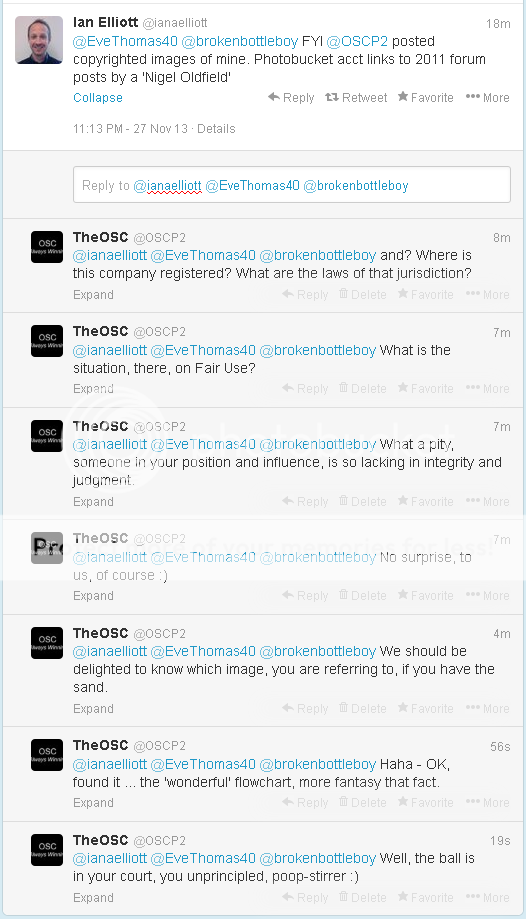
Addendum (28/11/13; 7:34 am)
Another White Knight steps up to the plate ...
https://twitter.com/ianaelliott
No contact with us, on the issue, first, of course :)
*****
More to follow.